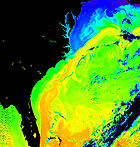
 The Gulf Stream is an ocean current that originates in the Gulf of Mexico, and then through the Straits of Florida, into the North Atlantic. In essence, it is a river within an ocean, and like a river, it can and does carry floating objects. It has a surface velocity of up to about 2.5 metres per second (5.6 mph). A small plane making a water landing or a boat having engine trouble can be carried away from its reported position by the current.
Monday, August 24, 2009
Gulf Stream
The Gulf Stream is an ocean current that originates in the Gulf of Mexico, and then through the Straits of Florida, into the North Atlantic. In essence, it is a river within an ocean, and like a river, it can and does carry floating objects. It has a surface velocity of up to about 2.5 metres per second (5.6 mph). A small plane making a water landing or a boat having engine trouble can be carried away from its reported position by the current.

Compass variations

Compass problems are one of the cited phrases in many Triangle incidents. While some have theorized that unusual local magnetic anomalies may exist in the area, such anomalies have not been shown to exist. Compasses have natural magnetic variations in relation to theMagnetic poles. For example, in the United States the only places where magnetic (compass) north and geographic (true) north are exactly the same are on a line running from Wisconsin to the Gulf of Mexico. Navigators have known this for centuries. But the public may not be as informed, and think there is something mysterious about a compass "changing" across an area as large as the Triangle, which it naturally will.
Supernatural explanations
Triangle writers have used a number of supernatural concepts to explain the events. One explanation pins the blame on leftover technology from the mythical lost continent of Atlantis. Sometimes connected to the Atlantis story is the submerged rock formation known as the Bimini Roadoff the island of Bimini in the Bahamas, which is in the Triangle by some definitions. Followers of the purported psychic Edgar Cayce take his prediction that evidence of Atlantis would be found in 1968 as referring to the discovery of the Bimini Road. Believers describe the formation as a road, wall, or other structure, though geologists consider it to be of natural origin.
Other writers attribute the events to UFOs. This idea was used by Steven Spielberg for his science fiction film Close Encounters of the Third Kind, which features the lost Flight 19 as alien abductees.
Charles Berlitz, grandson of a distinguished linguist and author of various additional books on anomalous phenomena, has kept in line with this extraordinary explanation, and attributed the losses in the Triangle to anomalous or unexplained forces.
Other Responses related Bermuda Triangle
When the UK Channel 4 television program "The Bermuda Triangle" (c. 1992) was being produced by John Simmons of Geofilms for the Equinox Programme, the marine insurer Lloyd's of London was asked if an unusually large number of ships had sunk in the Bermuda Triangle area. Lloyd's of London determined that large numbers of ships had not sunk there.
United States Coast Guard records confirm their conclusion. In fact, the number of supposed disappearances is relatively insignificant considering the number of ships and aircraft which pass through on a regular basis.
The Coast Guard is also officially skeptical of the Triangle, noting that they collect and publish, through their inquiries, much documentation contradicting many of the incidents written about by the Triangle authors. In one such incident involving the 1972 explosion and sinking of the tanker SS V. A. Fogg in the Gulf of Mexico, the Coast Guard photographed the wreck and recovered several bodies, in contrast with one Triangle author's claim that all the bodies had vanished, with the exception of the captain, who was found sitting in his cabin at his desk, clutching a coffee cup.
The NOVA / Horizon episode The Case of the Bermuda Triangle (1976-06-27) was highly critical, stating that "When we've gone back to the original sources or the people involved, the mystery evaporates. Science does not have to answer questions about the Triangle because those questions are not valid in the first place. ... Ships and planes behave in the Triangle the same way they behave everywhere else in the world.
Skeptical researchers, such as Ernest Taves and Barry Singer,have noted how mysteries and the paranormal are very popular and profitable. This has led to the production of vast amounts of material on topics such as the Bermuda Triangle. They were able to show that some of the pro-paranormal material is often misleading or inaccurate, but its producers continue to market it. Accordingly, they have claimed that the market is biased in favour of books, TV specials, etc. which support the Triangle mystery, and against well-researched material if it espouses a skeptical viewpoint.
Finally, if the Triangle is assumed to cross land, such as parts of Puerto Rico, the Bahamas, or Bermuda itself, there is no evidence for the disappearance of any land-based vehicles or persons. The city of Freeport, located inside the Triangle, operates a major shipyard and an airport which annually handles 50,000 flights, and is visited by over a million tourists a year.
Kusche's Theory
Lawrence David Kusche, a research librarian from Arizona State University and author of The Bermuda Triangle Mystery: Solved (1975) has challenged this trend. Kusche's research revealed a number of inaccuracies and inconsistencies between Berlitz's accounts and statements from eyewitnesses, participants, and others involved in the initial incidents. He noted cases where pertinent information went unreported, such as the disappearance of round-the-world yachtsman Donald Crowhurst, which Berlitz had presented as a mystery, despite clear evidence to the contrary. Another example was the ore-carrier recounted by Berlitz as lost without trace three days out of an Atlantic port when it had been lost three days out of a port with the same name in the Pacific Ocean. Kusche also argued that a large percentage of the incidents which have sparked the Triangle's mysterious influence actually occurred well outside it. Often his research was simple: he would go over period newspapers of the dates of reported incidents and find reports on possibly relevant events like unusual weather, that were never mentioned in the disappearance stories.
Kusche concluded that:
- The number of ships and aircraft reported missing in the area was not significantly greater, proportionally speaking, than in any other part of the ocean.
- In an area frequented by tropical storms, the number of disappearances that did occur were, for the most part, neither disproportionate, unlikely, nor mysterious; furthermore, Berlitz and other writers would often fail to mention such storms.
- The numbers themselves had been exaggerated by sloppy research. A boat listed as missing would be reported, but its eventual (if belated) return to port may not have been reported.
- Some disappearances had in fact, never happened. One plane crash was said to have taken place in 1937 off Daytona Beach, Florida, in front of hundreds of witnesses; a check of the local papers revealed nothing.
- The Legend of the Bermuda Triangle is a manufactured mystery... perpetuated by writers who either purposely or unknowingly made use of misconceptions, faulty reasoning, and sensationalism.
Origin of Bermuda Triangle
The term "Bermuda Triangle" was first used in an article written by Vincent H. Gaddis for Argosymagazine in 1964. In the article, Gaddis claimed that in this strange sea a number of ships and planes had disappeared without explanation. Gaddis wasn't the first one to come to this conclusion, either. As early as 1952, George X. Sands, in a report in Fate magazine, noted what seemed like an unusually large number of strange accidents in that region.
In 1969 John Wallace Spencer wrote a book called Limbo of the Lost specifically about the Triangle and, two years later, a feature documentary on the subject, The Devil's Triangle, was released. These, along with the bestseller The Bermuda Triangle, published in 1974, permanently registered the legend of the "Hoodoo Sea" within popular culture.
Why do ships and planes seem to go missing in the region? Some authors suggested it may be due to a strange magnetic anomaly that affects compass readings (in fact they claim Columbus noted this when he sailed through the area in 1492). Others theorize that methane eruptions from the ocean floor may suddenly be turning the sea into a froth that can't support a ship's weight so it sinks (though there is no evidence of this type of thing happening in the Triangle for the past 15,000 years). Several books have gone as far as conjecturing that the disappearances are due to an intelligent, technologically advanced race living in space or under the sea.
The Triangle area

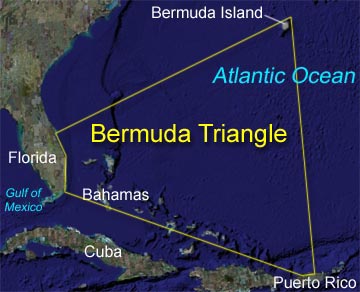
The boundaries of the triangle cover the Straits of Florida, the Bahamas and the entire Caribbean island area and the Atlantic east to the Azores; others add to it the Gulf of Mexico. The more familiar triangular boundary in most written works has as its points somewhere on the Atlantic coast of Miami, San Juan, Puerto Rico; and the mid-Atlantic island of Bermuda, with most of the accidents concentrated along the southern boundary around the Bahamas and the Florida Straits.
The area is one of the most heavily-sailed shipping lanes in the world, with ships crossing through it daily for ports in the Americas, Europe, and the Caribbean Islands. Cruise ships are also plentiful, and pleasure craft regularly go back and forth between Florida and the islands. It is also a heavily flown route for commercial and private aircraft heading towards Florida, the Caribbean, and South America from points north.
Subscribe to:
Posts (Atom)

 Posts
Posts


